


Gmail
Google LLC
I use Gmail as the place where personal messages, work conversations, receipts, travel details, and account notices eventually meet. It is a communication app from Google LLC, and its enormous reach is easy to understand: the basic service is free, it is available to everyone by age rating, and it works especially well when your daily life already touches other Google services. My experience is not that it is perfect, but that it is dependable enough to become the inbox I stop thinking about until I need it.
That distinction matters. Gmail is not exciting in the way a new social app can be, and it does not try to replace every messaging tool. Its strength is handling email at scale without making ordinary tasks feel complicated. I can search for an old conversation, reply from my phone, attach a document, or move an unwanted message out of sight with very little effort. At the same time, the app asks me to accept Google’s way of organizing mail, and some people will prefer a quieter, more private-feeling, or less feature-heavy alternative.
How Gmail fits into everyday communication
A free starting point with a very large footprint
Gmail is free to use, which makes the decision straightforward for someone who needs a conventional email address without paying an upfront purchase price. That is the clearest value fact here: I can install the app and begin managing email without buying the application itself. It is not a paid utility with a trial period, nor is it positioned as a premium client that requires a subscription before the inbox becomes useful.
Related News

CapCut Mastery: Unleash Hidden Features for Pro-Level Editing

Google Chrome: Your Essential Mobile Browsing Companion

How LINE: Calls & Messages Is Redefining Communication
The service has been available since September 21, 2010, and Google LLC has built it into a familiar part of everyday communication. The app has passed ten billion installs, while its average rating sits at 4.1 from roughly fourteen million ratings. Those figures do not prove that every person will enjoy it, but they do show why Gmail is often the default email choice when someone wants an established service rather than an experiment.
Its store category is Communication, and that description is accurate even though Gmail often feels like a productivity tool. Email can be casual, professional, administrative, or urgent, and the app handles all of those roles in one place. The Everyone rating also makes it approachable for households and mixed-age users, although the practical experience still depends on how each person manages their inbox and account settings.
Related News

Why WhatsApp Messenger Still Makes Everyday Communication Feel Easy

Jurassic World: The Game Is the Better Dino Tycoon for Strategic Players

Threads in Real Life: Who Should Join, Lurk, or Leave

How SHEIN Turned Shopping Into an Endless Content Feed

How to Make Fortnite Feel Smarter on Mobile

Should You Switch to Microsoft Outlook on Mobile?
The inbox is most useful when I stop treating it like a chat list
One of the first habits I recommend is separating “needs a reply” from “needs to be kept.” Gmail’s labels and folders make that possible, but only if I use them deliberately. A message can be archived without being deleted, allowing the inbox to stay focused while the conversation remains searchable. This is more useful than constantly deleting mail, especially when a booking confirmation, invoice, or old work decision may matter later.
I also find search more valuable than endlessly scrolling. Instead of remembering exactly where a message sits, I can search by a person, a phrase, a subject, or a recognizable detail from the conversation. The practical advantage is not just speed; it changes how I handle email. I do not need to build a perfect filing system for every message because search covers the gaps. For a busy inbox, that is one of Gmail’s most important strengths.
Labels are worth learning because they are more flexible than a simple “read” or “unread” state. I might use one for travel, another for household administration, and another for a long-running project. The trade-off is that labels can become cluttered if I create too many. My better approach is to keep a small set for recurring areas and rely on search for everything else.
Gallery
A realistic day with the app
Imagine that I am leaving for a weekend trip. A transport confirmation arrives in the morning, a hotel sends a check-in message in the afternoon, and a friend asks about the meeting point in the evening. Gmail lets me keep those threads in one communication history rather than scattering them across several services. I can search the hotel name when I need the address, star the message that contains the booking details, and reply to the friend without opening a separate email client.
That workflow sounds ordinary, but ordinary is where the app earns its place. I do not need to remember which device received a message or which app handled a particular account. If I later need the confirmation while standing at a station, the mobile inbox is more useful than a beautifully organized system I cannot access quickly. Gmail’s value comes from reducing that small amount of friction repeatedly.
Where Google’s wider ecosystem helps
The store summary presents Gmail as a way to connect, create, and collaborate with Google Workspace. In practice, that makes the app particularly convenient for people who already receive shared documents, calendar invitations, meeting information, or other Workspace-related messages. A work or study conversation can begin in email and lead naturally to a document or event without forcing me to rebuild the context elsewhere.
This does not mean Gmail replaces every Workspace product. Email remains the communication layer, not the full collaboration experience. If a team needs live discussion, task tracking, or document editing, another tool may still be the better place for that activity. Gmail is strongest when it keeps the invitation, explanation, decision, or follow-up connected to the rest of that workflow.
For independent users, the same integration can be either helpful or irrelevant. Someone who only wants a basic mailbox may never use the broader Workspace connection. In that case, Gmail still works as email, but part of its wider convenience is left unused. I would not choose it solely because of Workspace if my contacts and projects live somewhere else.
Small habits that make the mobile app easier to live with
On a phone, notification control matters more than many people expect. If every newsletter, automated alert, and low-priority conversation interrupts me, the app starts to feel noisy even when the inbox is technically well organized. I prefer to keep alerts for messages that may need timely attention and handle the rest during planned checks. This is not a Gmail-only issue, but the app becomes much calmer when I treat notifications as a filter rather than a live feed.
Another useful habit is reviewing the recipient line and attachment before sending. Gmail makes sending familiar, which can encourage quick mistakes. When a message includes several people or sensitive material, I slow down and verify who is included, whether the right conversation is open, and whether the attachment is actually the intended file. The app can make communication efficient, but it cannot replace careful judgment.
For long conversations, I pay attention to the thread rather than replying to the first visible message automatically. Threaded email keeps related replies together, which is convenient, but it can also hide the fact that a new reply has moved the discussion in a different direction. Reading the latest context before answering prevents the kind of misunderstanding that comes from treating an old subject line as the whole story.
Useful organization without turning email into a second job
Gmail’s best organizational tools are the ones I can maintain with almost no effort. Archiving finished conversations, starring something I need soon, and applying a small number of labels are realistic habits. A complicated system with dozens of categories may look impressive for a week and then become another source of work. I would rather have a searchable inbox with a few dependable markers than a perfect structure I stop maintaining.
Filters can help when the same kind of message arrives repeatedly. For example, recurring notifications or newsletters may be easier to handle automatically than one by one. The important trade-off is visibility: automation saves time, but it can also make a message less obvious if the rule is too broad. I recommend starting with a narrow rule, watching the result, and changing it only after seeing how real messages behave.
Gmail is also useful for separating urgent communication from reference material. A message requiring a response can remain visible, while a receipt or confirmation can be labeled and archived. That distinction is more practical than trying to keep every important message in the inbox. “Important” does not always mean “needs attention right now,” and Gmail gives me enough control to reflect that difference.
The trade-offs I notice most
The first limitation is that Gmail can feel busy. The inbox may contain personal mail, promotions, automated notices, social updates, and work conversations at the same time. Gmail offers ways to sort and filter that mixture, but the user still has to decide what deserves attention. Someone looking for a minimalist mailbox may find the experience more crowded than a privacy-focused or deliberately stripped-down email client.
Search is powerful, but it can encourage lazy organization. I sometimes postpone filing a message because I assume I will find it later. Usually that works, but not always: vague subjects, similar conversations, and incomplete memories can make a search harder than expected. Gmail reduces the need for manual filing; it does not eliminate the value of clear subjects, useful labels, or sensible archiving.
Threading is another mixed experience. Keeping a conversation together is excellent when the topic stays coherent, particularly for a long exchange with one person. It is less comfortable when the subject changes gradually or when several people use the same thread for separate questions. In those cases, a new message with a clear subject can be easier to follow than continuing an old chain.
Gmail is also not the right tool for every kind of communication. It is slower and more formal than a quick messenger for short back-and-forth conversations. It is not a substitute for a dedicated team workspace when a group needs persistent tasks, live collaboration, or structured project history. And if your priority is minimizing dependence on Google’s ecosystem, another provider may align better with your preferences, even if Gmail is more familiar.
How it compares with common alternatives
Compared with Apple’s built-in Mail experience, Gmail feels more centered on Google’s account and search approach. Apple Mail can be a natural choice for someone who manages several providers from an iPhone and wants a system-level inbox. I prefer Gmail when I want the same recognizable organization across devices and when my email life already connects to Google services. The better option depends less on raw features than on where the rest of your accounts and habits live.
Compared with Outlook, Gmail is often the more comfortable choice for people whose communication revolves around Google Workspace, personal accounts, and a simple web-connected workflow. Outlook can make more sense for users deeply invested in Microsoft 365 or an office environment built around Microsoft tools. I would not switch between them casually: the best client is usually the one that matches the calendar, documents, contacts, and work identity I already use.
Privacy-focused providers can be preferable for readers who place that concern above ecosystem convenience. They may offer a more focused experience or a clearer sense of separation from large platform services. Gmail’s advantage is familiarity, reach, and integration rather than being the obvious choice for someone who wants the smallest possible relationship with a major technology platform.
Who will get the most from it
I recommend Gmail to students, families, freelancers, office workers, and anyone who wants one established inbox for a mixture of personal and practical communication. It is especially useful when messages arrive from many different services and I need reliable search more than a carefully curated mailbox. People who change devices or move between mobile and desktop environments may also appreciate its consistency.
It is a strong fit for someone who wants to start free and learn gradually. I can begin by reading and replying, then add stars, labels, filters, and better notification habits as the inbox grows. That learning curve is gentle at first, but there is enough depth for users who need more control later. The app does not force advanced organization on me before I understand why I need it.
I would suggest caution for people who dislike automated sorting, crowded inboxes, or Google-centered workflows. If you want an email client that stays almost invisible and handles only a few carefully chosen accounts, a simpler alternative may feel better. Likewise, if your main communication happens through instant messaging, Gmail may be necessary for administration and accounts without being the app you open most often.
My verdict on the free value
Because Gmail is free, its value is measured in saved time and reduced confusion rather than in a paid feature package. In my experience, the combination of search, conversation history, organization tools, and Workspace compatibility delivers enough practical benefit to justify making it a primary inbox. I particularly value it when I need to recover an old detail quickly or keep a trail of decisions that would be difficult to reconstruct from short messages.
The free access does not make every trade-off disappear. I still have to manage notifications, avoid careless automation, and decide whether Google’s ecosystem suits my priorities. A free app can be poor value if it creates constant noise or does not match the way I communicate. Gmail earns its place when I use its strengths intentionally instead of expecting the inbox to organize itself.
For me, the buy-or-skip decision is simple: there is no purchase barrier to test it, so I would try Gmail if I needed dependable everyday email and already used Google services. I would skip it in favor of another provider if privacy positioning, a minimalist interface, or deep Microsoft or Apple integration mattered more than Gmail’s broad convenience. After years of email apps competing for attention, I find Gmail most convincing not because it is flawless, but because it handles the unglamorous details of communication reliably.
My recommendation: choose Gmail for practical, searchable email with free access and strong Google Workspace connections; choose something else when a quieter or more independent email experience is your real priority.
FAQs for Gmail
How can I manage multiple email accounts in Gmail?
Gmail allows you to manage multiple email accounts seamlessly through its interface. You can add other email addresses to your Gmail app and switch between them easily. Simply go to the settings within the app, choose 'Add account,' and follow the instructions to integrate accounts from providers like Yahoo, Outlook, or another Gmail address.
Is offline access available in Gmail, and how can I enable it?
Yes, Gmail supports offline access, allowing you to read, respond to, and search your emails without an internet connection. To enable this feature, go to your Gmail settings on a desktop, click on 'Offline,' and check 'Enable offline mail.' Choose your preferences for storage and synchronization, then save the changes.
How does Gmail protect against spam and phishing attacks?
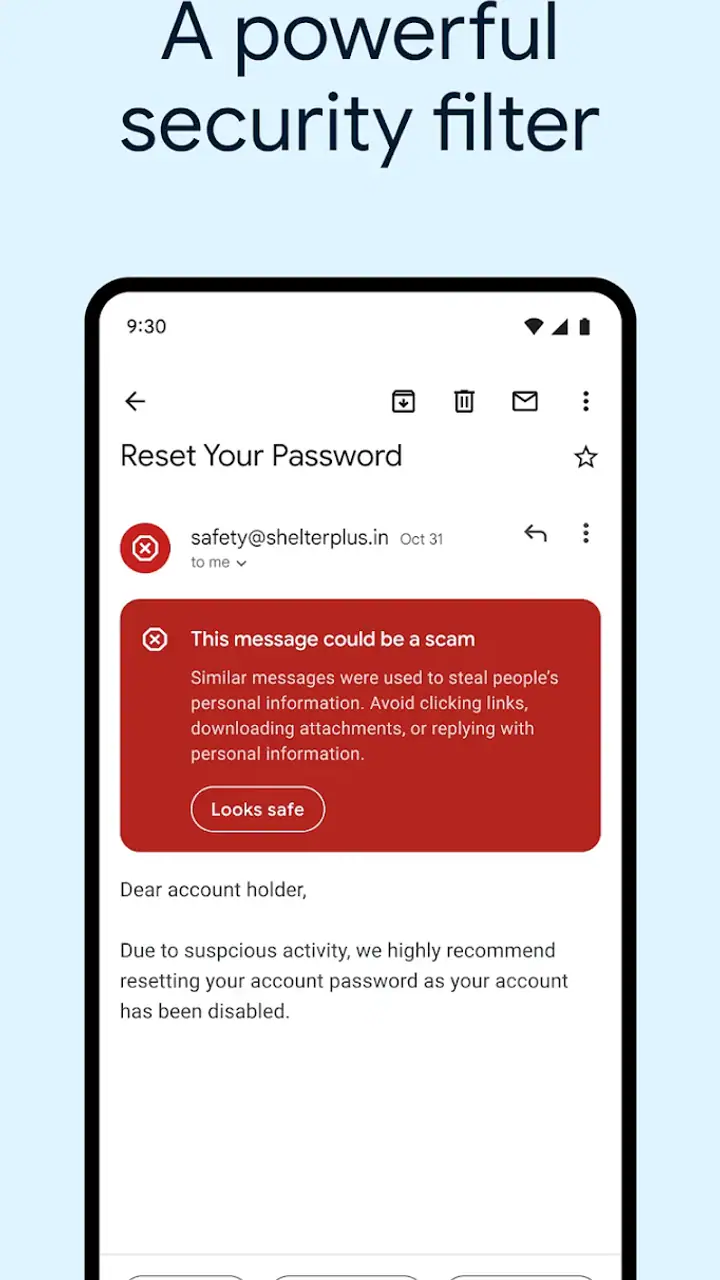
Gmail uses advanced machine learning algorithms to detect and filter spam and phishing emails, keeping your inbox cleaner and more secure. It automatically moves suspicious messages to the Spam folder. Additionally, Gmail provides warnings for potentially harmful emails and blocks most known threats before they reach you.
What are some productivity features available in Gmail?
Gmail offers several productivity features, including customizable labels for organizing emails, a powerful search function to locate messages quickly, and integration with Google Calendar for scheduling. The 'Snooze' feature lets you postpone emails to a later time, and 'Smart Compose' offers predictive text to speed up writing.
Can I customize the appearance of my Gmail interface?
Yes, Gmail allows you to customize its interface to suit your preferences. You can choose from various themes, switch between different density views, and adjust the layout. These options are available in the settings under 'Themes' and 'Display density,' allowing you to personalize your email experience.
Pros
- Intuitive user interface design.
- Seamless integration with Google services.
- Efficient spam filtering system.
- Robust search functionality.
- Customizable notifications.
Cons
- Limited offline capabilities.
- Occasional sync issues.
- Advertisements in promotions tab.
- Privacy concerns with data usage.
- No option to send encrypted emails.


